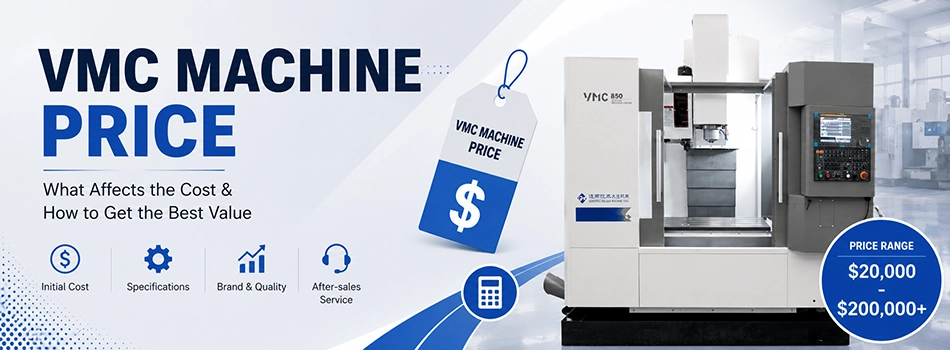
VMC Machine Price is often the first concern for buyers planning to purchase a vertical machining center. However, the real cost is not just the quotation number. It depends on machine size, spindle performance, CNC control, accuracy, tooling, options, installation support, spare parts, and after-sales service. A low price may look attractive, but the real value should be judged by long-term machining stability and total production cost.
This guide explains what affects VMC Machine Price and how buyers can compare vertical machining centers by configuration, application, service, and long-term value before making a purchase decision.
What Is a VMC Machine?
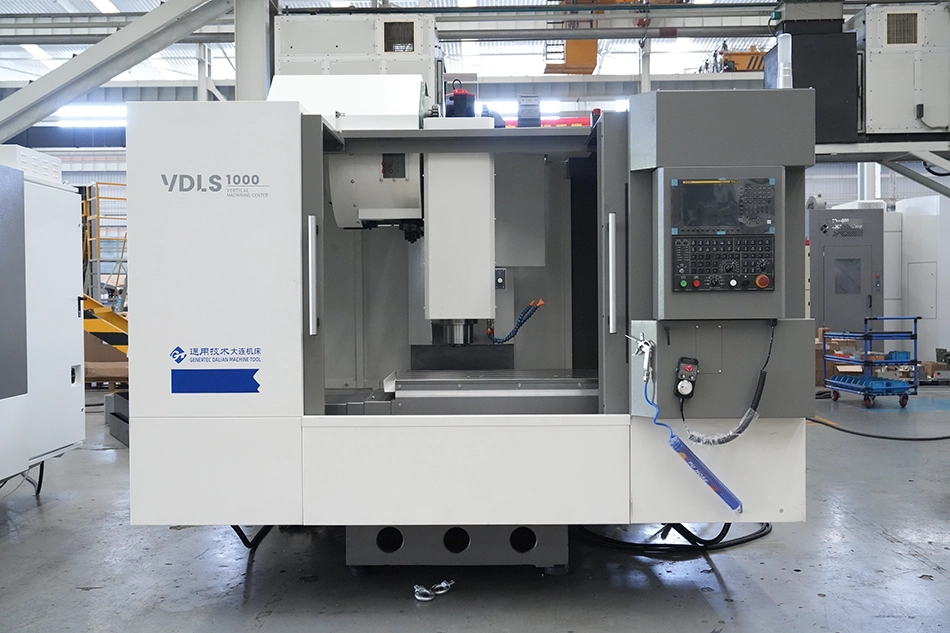
A VMC machine, also known as a Vertical Machining Center, is a CNC machine tool with a vertical spindle positioned above the worktable. According to industrial milling classifications, it is used for precision metal cutting processes such as drilling, tapping, and contour machining. Compared with a basic CNC milling machine, a VMC machine integrates a full CNC control system and automatic tool changer, allowing multiple machining steps to be completed in one clamping.
VMC machines are pivotal in manufacturing high-precision mold plates, automotive assemblies, and mission-critical aerospace components. To succeed in these demanding sectors, the equipment is engineered to comply with rigorous aerospace quality standards (AS9100D), ensuring the extreme consistency required for safety-critical hardware. This remarkable versatility allows them to serve as the backbone for industrial production across the electronics and energy equipment industries.
Because different industries require different spindle speed, rigidity, and accuracy, the VMC Machine Price can vary greatly. According to the 2026 CNC Cost & ROI Guide, price differences are directly driven by casting structure, CNC controller types, and assembly quality. These technical factors directly affect machining stability, tool life, and long-term production costs.
What Does VMC Machine Price Really Include?
VMC Machine Price is not only the cost of the machine body. A vertical machining center is a complete CNC production system. Its price usually includes the main machine structure, CNC control system, spindle system, feed axis components, tool magazine, cooling system, chip removal system, inspection, packing, and after-sales support.
For buyers, the quotation should be checked carefully. A lower VMC Machine Price may not always mean a better deal if important parts or services are excluded.
Main Cost Items Included in VMC Machine Price
1. Machine Casting and Structure
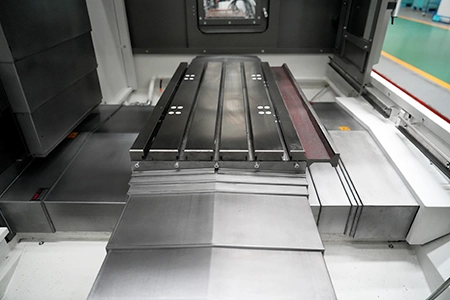
The base, column, saddle, worktable, and spindle head are the foundation of a VMC machine. Strong castings improve rigidity, vibration resistance, and long-term accuracy stability.
2. Spindle
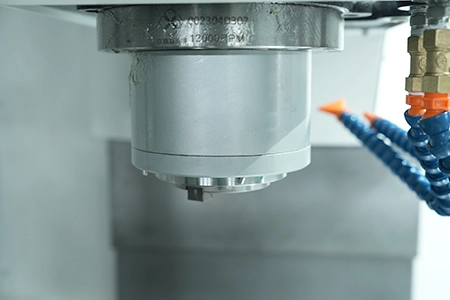
The spindle affects cutting speed, surface finish, tool life, and machining efficiency. Spindle taper, speed, motor power, bearing quality, and cooling design all influence VMC Machine Price.
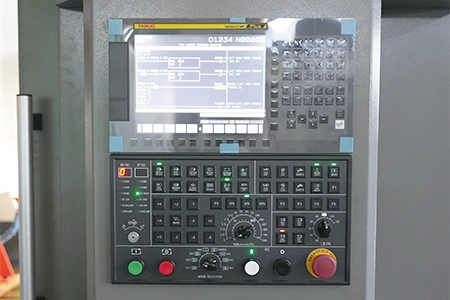
3. CNC Control System
The CNC controller affects programming, operation, servo response, accuracy control, and maintenance. Common options include FANUC, Siemens, Mitsubishi, GSK, and other CNC systems.
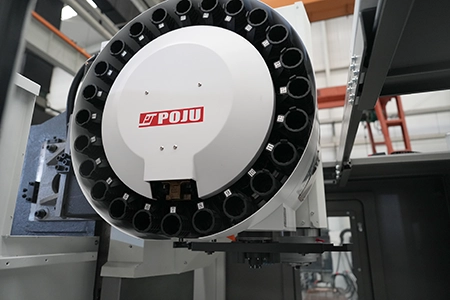
4.Tool Magazine and Automatic Tool Changer
The tool magazine allows the VMC machine to complete multiple machining processes in one setup. Tool capacity, tool change speed, and ATC reliability can change the final machine price.
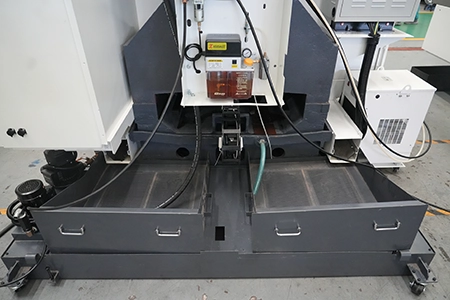
5. Cooling Lubrication and Chip Removal
Cooling, lubrication, and chip removal systems support stable daily operation. A reliable coolant system, automatic lubrication, and chip conveyor can reduce tool wear, manual cleaning, and downtime.
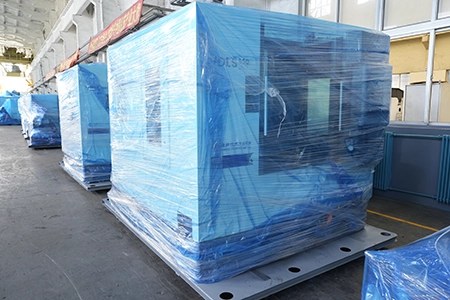
6. Inspection Packing and Service Support
A complete VMC Machine Price should also consider accuracy inspection, export packing, installation guidance, commissioning support, spare parts supply, warranty terms, and after-sales service.
Why VMC Machine Price Varies Between Suppliers
VMC Machine Price can vary greatly between suppliers, even when the machines have similar travel size or appearance. This is because a vertical machining center is not judged only by its model name. The real value depends on manufacturing quality, machine configuration, inspection standards, and service capability.
A lower quotation may look attractive, but buyers should check what is behind the price. Two VMC machines may look similar in photos, but their internal quality and long-term performance can be very different.
Main Reasons for VMC Machine Price Differences
1. Manufacturer Capability
A real machine tool manufacturer usually has stronger control over design, machining, assembly, inspection, and quality management. This can improve machine consistency and long-term reliability.
2. Casting and Machine Structure
Heavier and stronger castings usually cost more, but they can provide better rigidity, vibration resistance, and accuracy stability. A lighter structure may reduce price, but it may also reduce cutting performance.
3. CNC Control System
Different CNC systems create different price levels. FANUC, Siemens, Mitsubishi, GSK, and other controllers vary in cost, functions, operation habits, servo response, and service support.
4. Spindle Configuration
Spindle speed, taper, motor power, bearing quality, cooling method, and transmission type all affect VMC Machine Price. A high-quality spindle can improve cutting efficiency, surface finish, and tool life.
5. Guideway and Feed System
Linear guideways, box guideways, ball screws, servo motors, and axis protection systems influence machine accuracy and stability. Better feed components usually increase price but reduce long-term maintenance risk.
6. Accuracy Inspection Standard
Some suppliers only provide basic inspection. Others provide detailed accuracy reports, laser testing, ball bar testing, or trial cutting records. Stricter inspection increases cost but reduces purchasing risk.
7. Standard Accessories and Options
A quotation may or may not include chip conveyor, coolant system, tool holders, transformer, spindle oil cooler, fourth axis, probing system, or through-spindle coolant. Buyers should compare the full configuration, not only the machine price.
8. After-Sales Service and Spare Parts Support
Installation guidance, commissioning support, remote technical service, warranty terms, and spare parts supply also affect the real VMC Machine Price. For overseas buyers, service capability can be more important than a small price difference.
In short, VMC Machine Price varies because suppliers offer different levels of structure, components, accuracy, configuration, and support. Buyers should compare the complete machine solution instead of choosing only the lowest quotation.
Key Configuration Factors That Affect VMC Machine Price
VMC Machine Price is mainly decided by configuration. Two vertical machining centers may have the same travel size, but their price can be very different if the spindle, CNC control system, guideway, tool magazine, accuracy level, and optional functions are different.
For buyers, the key is not to choose the highest configuration. The key is to choose the right configuration for the workpiece, material, tolerance, and production volume.
| Configuration Factor | How It Affects VMC Machine Price | Buyer Should Check |
|---|---|---|
| Machine Travel and Table Size | Larger X/Y/Z travel, bigger worktable, and higher table load usually increase cost. | Workpiece size, fixture space, table load, and future production needs |
| Spindle Taper Speed and Power | BT40, BT50, higher spindle speed, stronger motor power, and better bearings increase price. | Material type, cutting depth, tool size, surface finish, and torque requirement |
| CNC Control System | FANUC, Siemens, Mitsubishi, GSK, and other CNC systems have different prices and service networks. | Operator habits, programming needs, local service, and maintenance convenience |
| Guideway Type | Linear guideways are often used for speed and efficiency. Box guideways are often used for rigidity and heavy cutting. | Machining material, cutting force, speed requirement, and rigidity demand |
| Tool Magazine and ATC | More tool positions and faster tool changing increase machine price but improve production efficiency. | Number of tools, process complexity, batch production, and tool change frequency |
| Accuracy Level | Higher positioning accuracy, repeatability, and inspection standards increase cost. | Workpiece tolerance, surface quality, inspection report, and trial cutting result |
| Cooling and Chip Removal | Chip conveyor, high-pressure coolant, through-spindle coolant, and oil skimmer add cost. | Material chips, deep-hole machining, cutting heat, and workshop cleaning needs |
| Optional Functions | Fourth axis, rotary table, probing system, tool setter, automatic door, and spindle oil cooler can increase price. | Whether the option directly improves machining efficiency or accuracy |
Axis Configuration: 3 Axis 4 Axis and 5 Axis
Axis configuration is another important factor that affects VMC Machine Price. Most standard VMC machines are 3-axis vertical machining centers. They use X, Y, and Z axes to complete common milling, drilling, tapping, boring, and contour machining processes. A 3-axis VMC machine is suitable for plates, brackets, covers, housings, mold bases, and many general machinery parts.
4-axis VMC machine usually adds a rotary table or fourth axis device. This allows the workpiece to rotate during machining. It is useful for parts that require multi-side machining, circular features, holes around a cylinder, or fewer clamping operations. A 4th axis increases the machine price, but it can improve machining efficiency and reduce positioning errors caused by repeated clamping.
5-axis machining center has more complex motion control. It can process complex surfaces, angled holes, impellers, aerospace parts, medical parts, and high-precision mold components. Compared with a standard 3-axis VMC machine, a 5-axis machining center usually requires a more advanced CNC system, rotary table, higher accuracy structure, better servo control, and stricter inspection. This is why its price is much higher.
For buyers, the best choice depends on the workpiece. If the parts are simple plates or housings, a 3-axis VMC may be enough. If the parts require multi-side machining, a 4-axis VMC can reduce setup time. If the parts have complex curved surfaces or high precision requirements, a 5-axis machining center may be more suitable.
In short, buyers should not choose more axes only because they look more advanced. The axis configuration should match the real machining process, workpiece complexity, accuracy requirement, and production budget.
How Buyers Should Choose the Right Configuration
A mold factory may need higher spindle speed, better surface finish, and smoother contour machining. In this case, spindle performance, CNC control, and accuracy should be the main focus.
An automotive parts factory may care more about repeatability, tool change efficiency, cooling, and stable batch production. In this case, tool magazine reliability, ATC speed, and long-term stability are important.
A machinery parts factory may process steel parts, brackets, plates, and housings. It may need stronger rigidity, higher torque, heavier table load, and better chip removal.
For aluminum parts, high spindle speed and fast feed can be more valuable. For steel and cast iron parts, rigidity, torque, and vibration resistance are more important than only spindle speed.
This is why VMC Machine Price should always be compared together with the actual machining application. A low-price VMC machine may be suitable for simple parts, but it may not be the right choice for precision parts, mold machining, heavy cutting, or long-time production.
In short, the best VMC Machine Price is not the lowest price. It is the price that matches the required configuration, machining accuracy, production efficiency, and long-term operating cost.
VMC Machine Price by Application Industry
VMC Machine Price is closely related to the application industry. Different industries require different spindle speed, rigidity, accuracy, tool capacity, cooling performance, and automation level. A machine used for mold finishing and a machine used for heavy steel cutting should not be selected with the same standard.
The table below shows how industry applications can affect Vertical Machining Center Price.
| Application Industry | Typical Workpieces | Key Machine Requirements | How It Affects VMC Machine Price |
|---|---|---|---|
| Automotive Manufacturing | Brackets, covers, housings, aluminum parts, fixture plates | Stable repeatability, fast tool changing, efficient cooling, batch production stability | Higher reliability, ATC performance, and cooling configuration may increase price |
| Mold Manufacturing | Mold bases, cavities, cores, inserts, electrodes, die components | High spindle speed, smooth contour machining, good surface finish, stable accuracy | Better spindle, CNC control, and accuracy inspection can raise machine price |
| General Machinery Parts | Plates, flanges, brackets, covers, housings, machine components | Balanced rigidity, torque, table load, drilling, tapping, and milling capability | Price depends on structure strength, spindle torque, and worktable capacity |
| Aerospace Components | Aluminum structural parts, titanium parts, precision components | High accuracy, repeatability, thermal stability, and strict inspection | Higher precision configuration and inspection standards increase CNC VMC Price |
| Medical Device Parts | Stainless steel parts, titanium parts, precision housings, instrument parts | Fine surface finish, stable dimensions, clean machining, accurate tool setting | Probing system, tool setter, and high-speed spindle may increase price |
| Energy Equipment | Pump parts, valve parts, compressor parts, equipment plates | Strong rigidity, high torque, durable cutting, larger table load | Heavy-duty structure and stronger spindle configuration can increase price |
| Construction Machinery | Steel plates, brackets, frames, structural parts | Heavy cutting, vibration resistance, strong chip removal, long-time operation | Box guideway, higher torque, and chip conveyor may raise the final price |
| Rail Transportation | Mounting plates, brackets, covers, structural components | Stable accuracy, rigidity, batch consistency, durable machining | Price depends on machine rigidity, accuracy retention, and service support |
| Electronics and Communication | Aluminum housings, heat sinks, covers, precision small parts | High speed, fast feed, good surface finish, efficient production | High-speed spindle and fast axis movement can increase machine cost |
How Industry Needs Change VMC Machine Selection
For automotive parts, buyers usually care about stable batch production. Tool magazine reliability, automatic tool changer speed, cooling performance, and repeatability are important.
For mold manufacturing, buyers usually focus on spindle speed, contour accuracy, and surface finish. A higher VMC Machine Price may be reasonable if the machine reduces polishing work and improves mold quality.
For machinery parts, buyers often need a balance between price and cutting capability. Rigidity, spindle torque, table load, and chip removal should be checked carefully.
For aerospace and medical parts, accuracy and stability are more important than low price. Buyers may need better CNC control, probing system, tool setter, and stricter inspection reports.
For energy equipment, construction machinery, and rail transportation parts, heavy-duty performance is usually more important. Strong machine structure, higher torque, box guideway options, and durable chip removal systems may increase the price but improve long-term production reliability.
In short, VMC Machine Price should be evaluated according to the real application industry. A low-price VMC machine may be suitable for simple aluminum parts, but it may not be suitable for mold machining, precision parts, heavy steel cutting, or high-volume production.
How to Compare VMC Machine Price Correctly
To compare VMC Machine Price correctly, buyers should not only compare the quotation number. A professional comparison should follow a clear step-by-step process. This helps buyers understand whether the machine price matches the real production value.
Step 1: Confirm the Workpiece Requirement
Before comparing VMC Machine Price, buyers should first confirm the workpiece material, size, weight, tolerance, surface finish, and machining process.
For example, aluminum parts may need high spindle speed and fast feed. Steel parts may need stronger rigidity and higher torque. Mold parts may require better surface finish and contour accuracy.
Without clear workpiece information, it is difficult to judge whether a VMC machine is suitable.
Step 2: Compare Basic Machine Specifications
Buyers should compare the core specifications of each vertical machining center, including X/Y/Z travel, worktable size, table load, spindle taper, spindle speed, spindle motor power, rapid feed speed, tool magazine capacity, positioning accuracy, repeatability, and machine weight.
Machines with similar model names may have very different structures and performance. A VMC850 from one supplier may not be equal to a VMC850 from another supplier.
Step 3: Check the CNC Control System
The CNC system affects programming, operation, servo response, accuracy control, maintenance, and service support.
Buyers should confirm the exact CNC controller brand and model, such as FANUC, Siemens, Mitsubishi, GSK, or other systems. A quotation that only says “CNC system” is not detailed enough.
Step 4: Compare Spindle and Cutting Capability
The spindle is one of the most important factors affecting VMC Machine Price. Buyers should check spindle taper, spindle speed, motor power, torque, bearing quality, transmission type, and cooling method.
A high-speed spindle is useful for aluminum parts and mold finishing. A high-torque spindle is more suitable for steel parts and heavy cutting. The right spindle depends on the material and machining process.
Step 5: Compare Guideway and Machine Rigidity
Guideway type and machine rigidity directly affect cutting stability and long-term accuracy.
Linear guideways are often used for high-speed and medium-load machining. Box guideways are often used for heavy cutting and stronger vibration resistance. Buyers should choose according to material, cutting depth, and production requirements.
Step 6: Check Standard Accessories and Optional Functions
A low VMC Machine Price may not include important accessories. Buyers should check whether the quotation includes coolant system, chip conveyor, automatic lubrication, work lamp, warning lamp, electrical cabinet cooling, transformer, tool holders, spindle oil cooler, or other accessories.
Optional functions such as fourth axis, rotary table, probing system, tool setter, through-spindle coolant, automatic door, and high-pressure coolant should also be evaluated according to real machining needs.
Step 7: Compare Accuracy Inspection and Test Reports
Accuracy should not only be written in the specification sheet. Buyers should ask whether the supplier can provide inspection reports, positioning accuracy data, repeatability data, laser testing, ball bar testing, or trial cutting results.
For precision parts, mold components, aerospace parts, and medical device parts, inspection standards are very important.
Step 8: Evaluate Service and Spare Parts Support
After-sales service is part of the real VMC Machine Price. Buyers should confirm installation guidance, commissioning support, remote technical service, warranty terms, spare parts supply, and response time.
For overseas buyers, service capability can reduce downtime and long-term maintenance risk.
Step 9: Calculate the Total Cost of Ownership
The real cost of a VMC machine is not only the purchase price. Buyers should also consider shipping, customs clearance, installation, tooling, fixtures, training, energy use, maintenance, spare parts, downtime, and scrap rate.
A higher-quality VMC machine may cost more at the beginning, but it may reduce hidden costs during long-term production.
Step 10: Make the Final Decision by Value
The best VMC Machine Price is not always the lowest price. It is the price that matches the buyer’s workpiece, accuracy requirement, production volume, service needs, and long-term operating cost.
A professional buyer should compare the complete machine solution, not just the initial quotation.
Low VMC Machine Price vs High Value VMC Machine
A low VMC Machine Price is not always a bad choice. It can be suitable for simple parts, light machining, small workshops, or buyers with limited budgets. However, buyers should understand the difference between a low-price machine and a high-value machine before making a decision.
| Comparison Item | Low VMC Machine Price | High Value VMC Machine |
|---|---|---|
| Suitable Use | Simple parts, light cutting, basic milling, drilling, and tapping | Precision parts, mold machining, heavy cutting, batch production, and long-term operation |
| Machine Structure | May use lighter castings or simpler structure | Usually has stronger rigidity and better vibration resistance |
| Spindle and Cutting | May be enough for basic machining | Better spindle performance, torque, speed, and cutting stability |
| CNC System | May use a simpler or lower-cost CNC system | More stable control, better servo response, and easier maintenance |
| Accuracy | Suitable for general tolerance requirements | Better positioning accuracy, repeatability, and accuracy retention |
| Standard Configuration | May include fewer accessories or basic functions | More complete configuration for real production needs |
| Service Support | May have limited technical support or spare parts supply | More reliable after-sales service and spare parts support |
| Long-Term Cost | Lower initial investment, but possible hidden costs | Higher initial investment, but lower downtime and production risk |
How Buyers Should Judge the Real Value
The real risk is not choosing a low-price VMC machine. The real risk is choosing a machine that does not match the workpiece.
For aluminum parts, high spindle speed and fast feed may create more value.
For steel parts, rigidity and torque may be more important.
For mold machining, surface finish and contour accuracy should be checked carefully.
For batch production, reliability, tool change efficiency, and service support can directly affect production cost.
A low VMC Machine Price may save money at the beginning. But if the machine cannot meet tolerance, surface finish, material removal rate, or production efficiency requirements, the buyer may face rework, tool damage, delayed delivery, outsourcing cost, or customer complaints.
Questions to Ask Before Confirming VMC Machine Price
Before confirming VMC Machine Price, buyers should ask practical questions. These questions help suppliers recommend the correct model and help buyers avoid wrong machine selection. A professional quotation should be based on the workpiece, material, tolerance, production volume, and required configuration.
1.what material will the VMC machine mainly process? Aluminum, carbon steel, cast iron, stainless steel, alloy steel, mold steel, titanium, and copper have different cutting requirements. Material affects spindle speed, spindle torque, tool selection, coolant, rigidity, and guideway choice.
2.what is the workpiece size and weight? Buyers should provide length, width, height, weight, and fixture space. The machine travel must be suitable for both the workpiece and the fixture. Tool length and machining clearance should also be considered.
3.what tolerance and surface finish are required? General machining and precision machining require different machine levels. If the workpiece has strict tolerance, buyers should pay more attention to positioning accuracy, repeatability, spindle runout, thermal stability, and inspection reports.
4.what machining processes are needed? Milling, drilling, tapping, boring, contour machining, and finishing require different tools and spindle performance. If the part needs many tools, tool magazine capacity becomes important. If the part needs deep hole machining, through-spindle coolant may be useful.
5.what CNC system is included in the VMC Machine Price? Buyers should confirm the controller brand and model. They should also consider whether local operators are familiar with the system and whether spare parts and service are available in their market.
6.what documents can the supplier provide? Professional buyers may need technical specifications, quotation details, packing list, inspection report, CE documents, test reports, user manual, electrical diagram, and spare parts list. These documents support internal approval, customs clearance, installation, and maintenance.
7.how will installation and after-sales service be supported? A VMC machine requires leveling, power connection, air supply, coolant preparation, lubrication check, parameter verification, and trial cutting. Buyers should confirm whether remote guidance, video support, on-site service, or local partner support is available.